| 0 | 7 Comments
| More

Randy

Pros and Cons of Ceramic Coatings (Paint) For Your Home

Eco_Seal_banner.JPG The Go Green Expo - Atlanta 2009  was chock full of interesting green products, services and solutions for home, lifestyle and then some. My interest was focused on homebuilding products and services (of course) and anything that would improve my lifestyle while at the same time lessen my impact on the environment. Basically, like many of you out there I'm trying to live greener as time goes on. This means putting into practice all of the green homebuilding products and services at my disposal whenever possible.

One of the products on display that interested me a great deal was a product known as Eco Seal. It is a ceramic coating applied to the exterior of your house. It is also known as ceramic paint or insulating paint. In this case, Vickie, with Southeast Coatings was demonstrating the benefits of Eco Seal, green and otherwise.


This is a permanent ceramic coating for your home and their marketing slogan is "Never Paint Again". It is a remarkable product that comes with a 25 year transferrable warranty and has a lot going for it besides the longevity aspect. Allow me to explain.
 

Ceramic coatings used as an insulating paint on homes and buildings have been around for quite some time now (20+ years) under a multitude of brand names. So it would seem that if they didn't perform as promised you would have read about it somewhere if you knew where to look. There seem to be a few skeptics out there that can't seem to wrap their mind around the insulating properties and benefits of ceramic paint and exactly how it works. 

Vickie gave me a hands-on demonstration of the waterproof properties of the adhesive primer sealer (first coat of the application) by way of a folded paper towel that had been previously coated with the primer sealer, allowed to dry and then placed in a bowl of water. The paper towel was still intact. Cool.
 

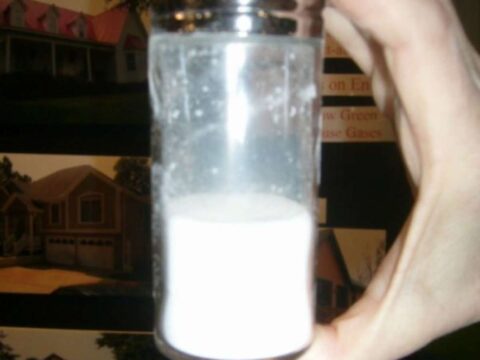
Eco_Seal_ceramic_micro-spheres.JPG I was also given the opportunity to see and touch one of the key ingredients of the paint...the ceramic micro-spheres. It was a bizarre tactile sensation. I was invited to stick my finger in the vial of micro-spheres. I was slightly hesitant but went with the moment. I didn't feel a thing. I had to look at my finger through the jar to realize that it had been totally surrounded by the micro-spheres. Weird, weird stuff!
 

The elasticity of the product was then demonstrated by giving me a 6" x 6" square of the ceramic paint "chip" (or strip) that had been peeled away in a nice sheet. It was like a rubber membrane that could be stretched in any direction and still retain its' original shape. This stuff is especially recommended for coastal residents for it's corrosion resistance and salt tolerance. It has proven to provide better protection than Rustoleum, the industry standard in that category.
 

Pros of Applying Ceramic Paint to Your House 

I find it interesting that Eco Seal primarily stresses the longevity of the product and then follows that with the other extraordinary benefits of ceramic paint within their literature. Below are some of the outstanding properties and benefits of ceramic coatings when used as an exterior paint solution for your home:
 

  • Longevity - It comes with a 25 year transferrable warranty from chipping, peeling or flaking. "Never Paint Again" is the big selling point in large bold letters in their literature.
  • Class A fire and smoke rating
  • Mold and mildew resistant. Also less likely for wood rot to occur due to the properties of the Eco Seal adhesive primer sealer. It's sticky. I tuched a small piece of siding used for demonstration purposes.
  • It is permanent: Permanently bonds with any paintable surface.
  • Flexibility - expands and contracts with changing temperatures. This is key to the warranty, in my opinion.
  • Breathable: It has a breathability (perm) rating of 32.7. That simply means that it keeps water particles out but allows water vapor to escape from the interior, thus reducing the chances of mold and mildew occurring.
  • Lower V.O. C.'s - They state that it rates at 81.6 g/l compared to approximately 200 g/l of traditional house paint.
  • Variety of colors to choose from...just like paint.

Eco Seal Ceramic Coating has their own formula that has undergone independent testing by BASF, 3M, and The American Society for Testing and Materials. I invite you to read all of the more in-depth test results for yourself.


Cons of Eco Seal Ceramic Coating Paint

Cost - on the front end it is about 2-3 times what you would pay for a typical paint job on your house per Vickie @ Eco Seal. The key words there are "on the front end". But if you think about it, it's not really a negative because once this product is applied, you're good for a long while...guaranteed.
 
Other than that, the only other con would be that you had better choose a color that you're going to be happy with for a very, very long time.

I implore you to read the tree hugger article on ceramic insulating paint along with the insightful and thought-provoking comments from readers that follows the article. Great discussion and questions are raised there regarding thermodynamics and more.


Why Is Eco Seal Considered a Green Product?


  • Lower V.O.C.'s than traditional house paint means lower greenhouse gas emissions
  • The ceramic micro-spheres reflects up to 90% of the sun's rays, therefore, reducing the surface temperature of your siding. It is because of this that Eco Seal has a Low-E rating (same as energy efficient windows). This will save energy (and money) right out of the gate.
  • Saves trees. The primer bonds with the substrate forming a permanent seal from water. That means you won't need to replace any rotten boards on your home for a long period of time.
  • It is "landfill friendly" if disposal is required. (I'd like to see more data on this claim by Eco Seal)

 
Okay...in my opinion, this is an excellent product with great attributes based on the test results I read. It's proven to work by well-known independent laboratories so I feel comfortable recommending this product and others like it. I will have to reserve judgement on this product until further notice die to the enormous amount of research required to come to any sort of conclusion. It would be great to go back to the homeowners 5 years after it has been applied to see if their energy bills have been reduced, etc. by the amounts that these manufacturers claim they will be reduced.

Update 07/04/2009: Upon further research, I DO NOT feel comfortable recommending a ceramic coating for use as a house paint...roof paint...possibly. The laws of physics dictates that some of the claims made for this product are not possible, as least not to the extent to which they are claimed. I'm not afraid to admit when I'm wrong and this looks like one of those times.  A reader of The Fun Times Guide To Homebuilding has given me food for thought on this subject by challenging the claims made by the manufacturer of this product (and others like it) in ways that are, honestly, best left to scientists and engineers to prove or disprove. I can only absorb their findings and report them here...which I plan to do sometime in the near future. The best I can do right now is to tell anyone who may be interested in covering their home with a ceramic coating, is basically "BUYER BEWARE".


Related:

I wrote an article about another brand of ceramic paint called Insuladd a couple of years ago. Similar product with outstanding characteristics claimed by the maker.


Bob Vila's website also has a point of view regarding ceramic coatings and how it works.

HY-TECH is another company that sells ceramic paint and additive with reasons why their brand is the real deal.

Lloyd Alter at TreeHugger has a good article on ceramic insulating paint with lots of interesting comments from readers.

Bob Formisano at About writes about the different aspects regarding ceramic insulating coatings


7 Comments

Dave

My main issue is the use of a known brand name (3M) in efforts to prop up your product. Yes that is a known brand name and they also make great scotch tape.
Your website is the source of information I have been referring to not 3M. http://ecosealpaint.com/testing-and-quality
The two paragraphs below are from the Eco Seal Paint website. The statements made on your site will have us believe a test done by 3M shows the ceramic micro-spheres “are excellent at blocking heat transfer” and “the ceramic spheres do a great job stopping thermal transfer” yet no where in the test results (below) does it say this at all. In fact it shows the study included 3 different products introduced by 3M which “can increase or decrease thermal conductivity”.

Statement on your site:
“3M Microspheres
Ceramic micro-spheres are excellent at blocking heat transfer. This study conducted by 3M measures the thermo conductivity of the 3M spheres against CaCo3. Eco Seal utilizes 3M ceramics as the primary solid in its coating while CaCo3 is the solid found in traditional paint. As you can see, the ceramic spheres do a great job stopping thermal transfer. In contrast, the CaCo3 transfers heat and is highly thermo conductive. Click here to read more…”

3M Microspheres Thermal Conductivity Report http://ecosealpaint.com/wp-content/themes/RS/3MMicrospheres1.pdf
“Results
Scotchlite Glass Bubbles reduced the thermal conductivity of both resins.
With Z-Light Spheres Microspheres thermal conductivity increased slightly
Zeeosheres Microspheres provide higher thermal conductivity when enhanced heat transfer is preferred.”

Not only does it not identify which component is in your product it does not provide any indication how it will react to heat in a measurable way once it is mixed into your paint. The 3M testing was done using "silicone and epoxy resins" not Ecoseal Paint! Another important point is that one of your competitors apparently tested more than 3,500 ceramic components with NASA and chose 4 different ceramics for their coating. This was over 15 years ago therefore this is hardly brand new technology which was what I was pointing out to Randy. The single ceramic coatings is old school technology that is limited to reflection only. This will minimize over time once the coating gets dirty and of course when you tint to different colors than what has been tested.

ENERGY STAR has to be one of the easiest certifications to acquire for a reflective roof coating so that is hardly compelling. White paint has an average emissivity value of about .90. How does Eco Seal compare? Your website shows “n/a” for both Solar reflectance and Emissivity. http://ecosealpaint.com/wp-content/themes/RS/ES-Lab.pdf

The problem is Jeff, there is no “back up information” on your website you say is there that supports claims that your product will outperform other ceramic coatings in blocking heat transfer. This has been another primary issue as per my “smoke and mirrors statement” I made earlier. When you claim to be “the ceramic coating leaders” you had best be prepared to back it up with some good solid testing. From my point of view you are perhaps 15 years behind the competition. Prove me wrong.

Jeff

Dave,
I've been in the painting buisiness for over 26 years and got into Ceramic Coatings in 2000. Yes, as in anything there are product claims that exceed what the product actually does.
In referrance to your comment about "glass" microsheres, if you will look deeper into 3M's website you'll see they make 2 types of microspheres; glass and ceramic. (as well as other ceramic particles). Eco Seal uses 3 different size spheres, so as the resins cure the round particles compact more tightly, as well as "platelets". The one thing I can agree with you on is that "glass spheres" don't have the strengh to withstand the manufactering process much less going through an airless sprayer without breaking apart. That is why Eco Seal uses "Ceramic" microspheres. They are lab tested to have a strength of 60,000 psi! Ceramics have a wide variety of uses to control heat transfer, however, I don't know of any type of insulation that controls radiant, conductive and convective heat. Eco Seal's formulation has the Energy Star Rating but was tested on roofs. I really don't see how the DOE could do accurate testing on siding because of all of the variations of houses in general. The same principles would apply to a buildings walls exposed to direct sunlight as would a roof. Ceramic coatings don't have an r-value as fiberglass, cellulose or foam offer but an E-rating (Emissivity) This is a measurement of reflected radiant heat from the surface.
Another interseting thing I have found in my own research is that there is a law of physics that states temperature and sound must follow mass. Since the microsheres have a hollow vaccuum center, doesn't that mean that conduction of temperature and sound would be reduced?
There is no "silver bullet" product that comes in a single container that completely eliminates all of the maintenance and energy issues that property owners face, but Eco Seal is on the right track. 3M is a global, credible company and the use of ceramics are really a simple ingredient in Eco Seal that is beneficial in reducing the amount of heat that is conducted through the coatings surface.
We are, after all, comparing these ceramic particles to calcium carbinate that ALL paints use as their solid componant. If you not aware of it, that is what the powder stripes on athletic fields are. Do you think that has any benifit to thermal conduction?
I don't see any claims that are not backed up.
In Randy's behalf, what he saw at the Go Green Expo in Atlanta was a simple demo of how the product works. I think we have all agreed that we are not scientists but I don't see where we need to be with all of the back-up information available to you about Eco Seal.

Benjamin Moore Paint

Any advice on which name brand paint is better? I've heard benajmin moore has the better variety of colors and finishes but Behr lasts longer? Can anyone verify or deny?

Dave,

Now that's more like it. Now your comment seems directed more towards the product rather than the author of the article.

When I decided to write about ceramic paint, the more I read about it the more complicated it became. This is a topic that could easily have a blog all on its' own. When I have the time, I will piece together a follow-up post to reference more data, etc..

Can I assume that I can tap your 9+ years worth of study on this product and that you'd be able to provide me with a few links to some of the more critical data that gets down to the nuts and bolts of this product? It would be appreciated.

Dave

Randy, you seem to have missed my point and are now mixing apples with oranges. Granted you have confirmed you aren't representing this product, that I believe more than ever. I never commented on the BASF testing results because they have nothing to do with the apparent thermal performance this product claims to have which is my core issue with this product. The only item on the list that makes any reference to thermal performance is ASTM E903 - Solar Reflectance which states "n/a" whatever that is supposed to mean, not available?, not applicable? Regardless, the bulk of the BASF test results essentially describes nothing more than an elastomeric coating. Nothing in the BASF testing makes reference to ceramics and the tested performance of ceramics when introduced to heat which was apparently the purpose of this article you wrote.

Remember it is you who titled this article, "Pros and Cons of Ceramic Coatings (Paint) For Your Home"
You don't actually discuss any other ceramic coatings except Eco Seal yet the title implies this article will provide useful information on "ceramic coatings" in general presumably to help one make an informed decision. What I am also pointing out is the clear lack of evidence of insulation performance of this one product you are gushing over. 99 % of your article is in support of this one product you say you never even tried. On the other hand you provide one small single paragraph for the "Cons", that being the cost difference to standard insulations. Again, in my view you fall short in explaining the downside to the ceramic coating industry such as the misperceptions, the misinterpretations, the false claims, the lack of 3rd party testing etc. If you're going to write an article that purports to tell all then at least make a balanced effort to tell both sides of the discussion. That is why it appeared to be a mere sales pitch for one single product.

With regards to the 3M article you have completely missed my point which I still stand by.
It is you who invites the reader of your article to look at the so called "in-depth test results" Here is your statement :
"Eco Seal Ceramic Coating has their own formula that has undergone independent testing by BASF, 3M, and The American Society for Testing and Materials. I invite you to read all of the more in-depth test results for yourself."

And here is the Eco Seal statement leading us to the same test :
"Ceramic micro-spheres are excellent at blocking heat transfer" (yet the 3M article does not state this at all, the statement is misleading)

If you had actually read this dated article you would have seen that it does not even mention the Eco Seal product at all yet you and Eco Seal want us to look at it as though this provides the defining proof. All it shows is that 3M did their own in house testing on their own microspheres to show that "The addition of 3M Microspheres to a resin can increase or decrease thermal conductivity in parts and films. " The article earlier stated that "RTV silicone and epoxy resins were used for commonality and workability" It does not even support the Eco Seal product in any way yet they (and you) refer it to as "an in depth study" of the underlying technology for the Eco Seal product. All it discusses is that the glass microspheres (Scotchlite Glass Bubbles) "reduced the thermal conductivity of both resins" The resins they tested are not even the same ones used in the Eco Seal product!! The bottom line here is there is little to no support that proves the Eco Seal product has any thermal benefit. If they really want credibility then they need to get the product tested on its' own merit and not try to rely on a speculative test of one of its' components.

Even if there was some thermal benefit by using this product it falls short in that it does not I repeat it does not address ALL THREE FORMS OF HEAT TRANSFER!! which in order to be an outstanding thermal insulator is a must have otherwise it is just another cheap knock off of technology that has existed for 20+ years now. This is more of an attempt at 1st generation when the technology is at the 2nd and 3rd generation stage.

Don't feel too hard done by that I have picked your discussion apart. You aren't a scientist or an engineer and nor am I however I have researched these products for the past 9+ years now. I have seen many of these companies come and go. In fact you will find some of them have been taken to task through the courts by the Federal Trade Commission in the USA and by the Competition Bauer in Canada. My background is criminology which like other sciences I expect to see hard measurable evidence or empirical proof. On the positive side you have opened up a discussion that may continue where we can all learn from. Here is a link to an ongoing discussion similar to this that has taken place for several months now. http://www.treehugger.com/files/2008/07/ceramic-insulating-paints.php

Dave,

Who yanked your chain, fella??? Sales pitch my ass!!! I have ABSOLUTELY NO CONNECTION with Eco Seal and THEY DO NOT COMPENSATE ME in any shape, form or fashion. I'm guessing that you are employed by a competitor of some sort...just a guess...by the tone of your comment.

Yes, it's true. I'm not a scientist, architect or an engineer (I'm a homeowner and a consumer) but everything I read about ceramic coatings 2 years ago when I wrote my first article about a different brand of ceramic coating (they didn't compensate me either) and most recently while I was researching for this post leads me to believe it does what it claims. By the way, the BASF test results ARE 3rd party, and based on ASTM standards. Read the report, Dave. It reads "ASTM" all up and down the file.

Regarding the 3M report...dated or not...doesn't matter. Scientific data will hold true no matter the date.

I did read up on all of the test results from the various 3rd party labs and gave my recommendation based on that. I've never personally used Eco Seal before but the lab results sold me. That's all there is to it, Dave. This was not a testimonial, it was an article about the pros and cons of ceramic coatings and I invited the reader to absorb the test results for themselves. The rest is up to the consumer...Dave.

Where is YOUR data to back up your broken glass spheres comment? You've got to do better than that if you're going to theorize.

p.s....I'll grant you the "green bandwagon" comment. Many, many companies do work that angle to sell their wares, but there must be some validity to it in order for them to proclaim that fact. Eco Seal has a few green points to their product but I'd like to see it more eco-friendly, of course..

Dave

The writer of this article has failed to adequately research this topic and appears to lack the technical insight about both ceramic technology and heat transfer technology. This leads me to believe this is simply another smoke and mirrors sales pitch for a product that lacks real data.

This is yet another knock off single ceramic coating with a new sexy name in attempts to jump on the so called "green bandwagon". On the other hand this is likely an old product with a new name slapped on it. You will note the date on the article (June 1998) outlining the 3M "glass spheres". There have been numerous names created out there flogging a product using the same glass spheres. Just because the technology has existed for several years does not warrant support for this product. Like other good technologies, there are always going to be those who try to sneak in the back door and claim to be the same.

Another point about the 3M glass spheres, yes that's right, "glass". So how stable do you think glass bubbles are once you have paddle mixed the coating prior to application? How effective are they going to be once they have broken?

You will also see in their own article that all that is mentioned is the ability of the glass spheres to conduct heat in comparison to other 3M ceramics. First of all this is not 3rd party testing it is a test conducted using their own products. All this article tells you is that the glass spheres conduct less heat than the other 3M products, so what? What does that tell me about how they perform against other ceramic products that are not 3M?

Perhaps the most glaring oversight is the fact that only one of three forms of heat transfer is addressed. The dated 3M article is called "3M Microspheres Thermal Conductivity Report" The title in itself tells you right there that this product is inferior to the true insulating ceramic coatings which use multiple ceramic types to address all three forms of heat transfer.

If you really want to provide good useful information to the consumer then advise them to look for 3rd party testing and certification. ASTM is perhaps the most widely used and accepted standard in North America by engineers and architects. Don't rely on testimonials alone. Like the knock offs, they can be easily fabricated.

Leave a comment

Signing in is easy! Especially if you use OpenID or one of these networks:

Movable Type OpenID Vox TypePad Yahoo AIM Facebook WordPress.com
what will you say?

(You may use HTML tags for style)

Recent Comments