Are you considering installing a natural gas range in your home?
I installed a gas range in our home recently — yes, by myself. And I have some great practical advice before you install a natural gas stove in your own home.
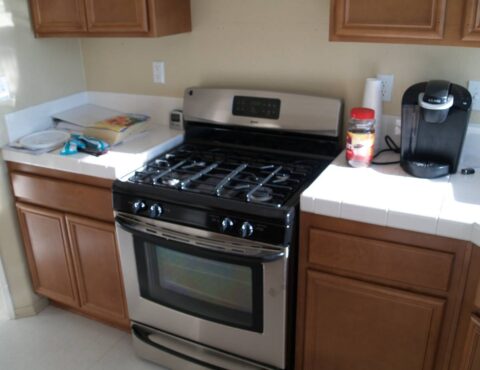
I also had to add onto the existing natural gas supply line in my home to make this work.
It’s been quite an ambitious learning experience for me. But it’s also been a rewarding one, as well.
Why? Because it was easier than I thought. And I saved a wad of cash.
We switched out our old electric coil range with a natural gas range.
See why we chose to install a gas range instead of an electric range.
If you’re thinking about doing the same (or if you want to extend your existing natural gas lines to a new outdoor grill), then I invite you to get comfortable and heed the advice I’m sharing in this article.
The same principles will apply in dealing with cast iron pipe. Put your common sense on overdrive, and read on.
Part 1 – How I Installed A Gas Range & Supply Line
Disclaimer: I am NOT a licensed plumber. I am simply sharing my experience with installing a gas range in my own home. Ask for advice from professionals before considering this type of project, then add my practical experience for good measure. If you have ANY reservations about attempting this type of project, call a professional to handle it for you. This is NOT a project to be taken lightly. Check with your homeowners insurance for details on this project before attempting. If you choose to follow the techniques, approaches, and methods shown here, then you follow them at your own risk.
The information in this article assumes that you have natural gas previously available in your home.
- Research brands and comparison shop.
Make sure you do your homework and shop the best brands out there.
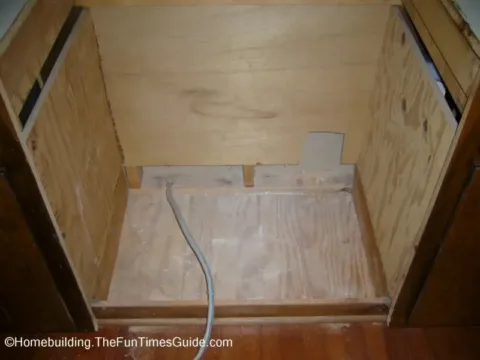
- Pull out the old stove and measure the space for the newly chosen gas range.
Most stoves are 30 inches wide.
Our old range was a drop-in model – so I needed my measurements to be accurate, due to switching to a free-standing range.
- Retreat to headquarters (home). Mull it over. And then make a decision (aka harass my wife into letting me have the stove I craved).
- With a measuring tape and digital camera in hand, go out and make the purchase.
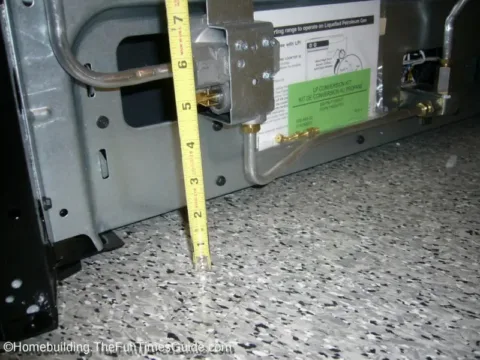
TIP: If the model you are purchasing is on the sales floor, I suggest you take measurements AND take photos of the range and where the gas connections are on the stove. These will come in handy!
Be sure to inquire about the gas connector and diameter. Also ask what type of electrical connection you will need to have available for the stove to operate on.
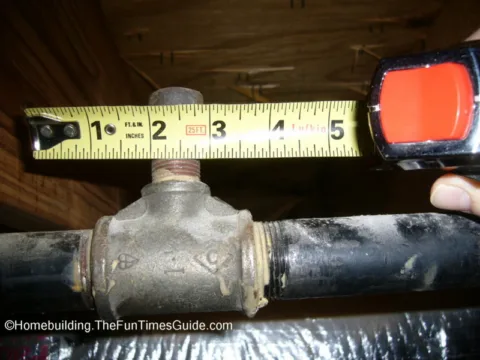
- One of the first things I did was locate the nipple where I would be connecting the additional pipe. Then, measure the outside diameter.
Cast iron pipe that is 7/8″ outer diameter equals 1/2″ pipe in the store — meaning that they only go by the inside diameter. I took measurements from where it would connect all the way to where it would end up behind the stove.
- I read up on the possibility of tapping into the existing gas line in my house.
I saw that if I was careful and followed code (and common sense), I could save myself a bundle of money.
I think I ended up saving somewhere between $250 to $350 doing this project myself, based on conversations with a contractor and employees at Home Depot and at Lowe’s. I spent just under $50 on materials — including $20 on a new pipe wrench.
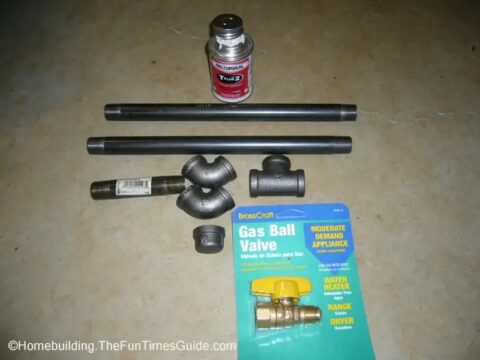
Other supplies included: 2 elbows, 1 t-connect, 1 long piece of pipe and 3 short lengths (all cut to my measurements), cap, T2 pipe joint compound and the valve.
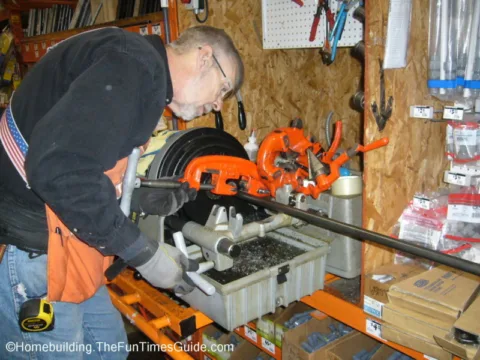
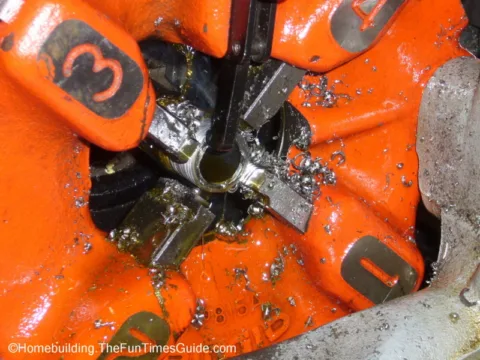
I had the associate at Home Depot cut to length those 3 short pipes to my specifications. He cut them, reamed them, and then threaded them — all on one machine. It took about 10-15 minutes due to the constant interruptions from other customers and Depot associates asking this guy questions.
I obviously had one of the more experienced employees on site. That made me feel good about the advice I was given and confirmed what I had read on a couple of other websites.
- I shut the gas off at the meter.
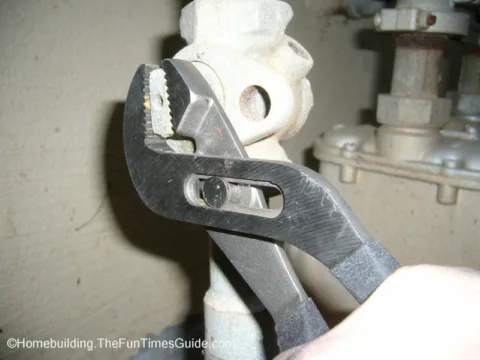
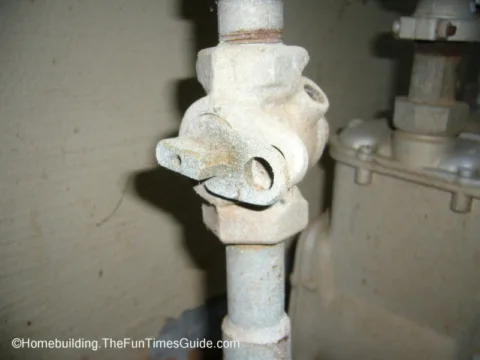
Once I had all of my supplies on hand and made an announcement to everyone in the house not to strike a match, etc., I shut off the gas at the meter on the outside of the house. It only takes a pair of pliers to accomplish this task.
TIP: Be sure to line up the hole on the part you are turning with the stationary hole on the meter. Then put a padlock through it until you have completed the job! You only need to turn it 1/4 of a turn. It’s a ball valve — so it will turn either way indefinitely. Just line it up and put a lock on it.
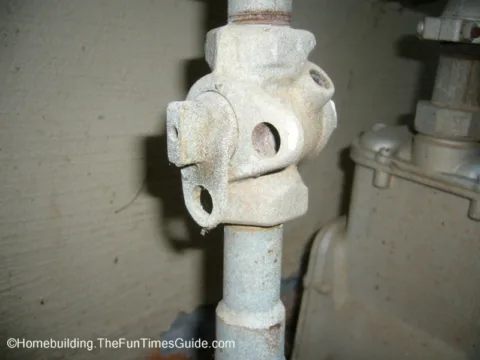
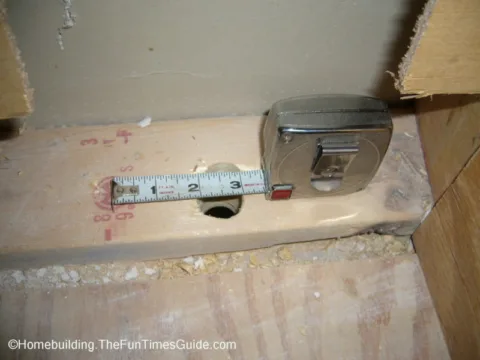
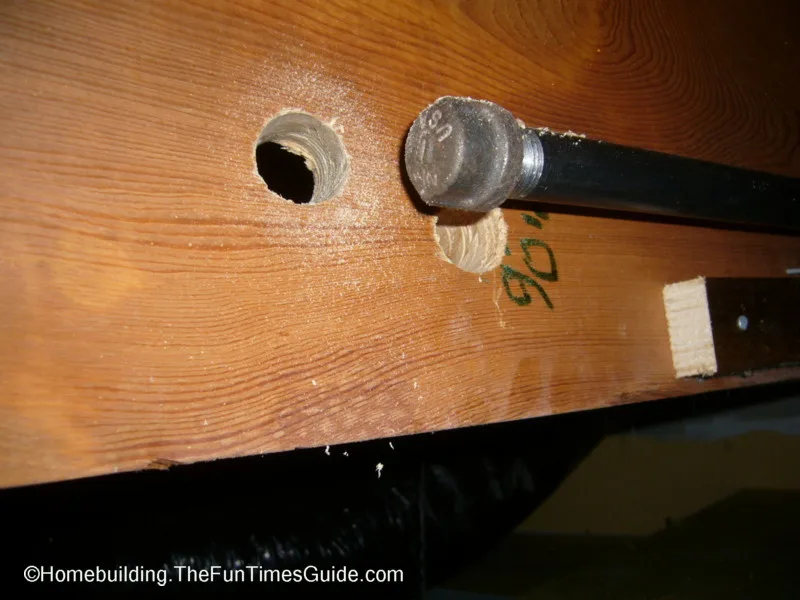
- Next, I pre-drilled 1-inch holes for the pipe in the floor behind the stove and through the floor joist for the 90-degree turn I had to make.
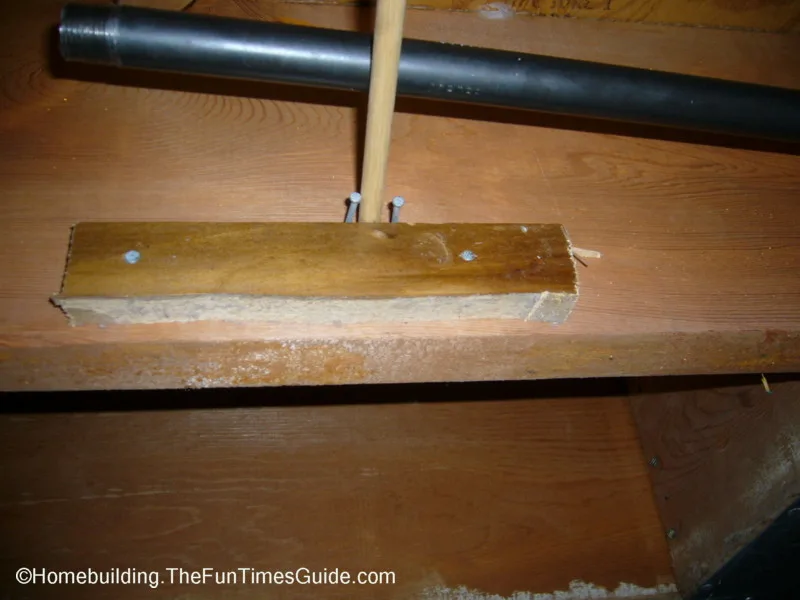
I also made a temporary brace between the floor joists for the unattended end of the 90-inch pipe to rest on, while I made the connection.
In hindsight, I should’ve waited to drill the hole through the joist until I had the pipe from the main line connected and was ready for my next move through the joist. Or, I could’ve taken off about 3 inches from the 90-inch pipe to accurately align it towards the hole through the floor joist for the pipe.
Why? Because by the time I was at the point of putting the pipe through the hole in the joist, I had added two 90-degree elbows (one from the existing gas line and one to turn towards the joist), thus adding about an inch or so per elbow — due to the threads and the elbow itself.
The result was that I ended up re-drilling another hole next to the originals. What can I say?… We live and learn!
- When I was finally ready to begin, the BIG moment was upon me. I eased the cap off of the nipple first.
Nothing herky-jerky here, folks. Go nice and slow! In my case, it was a little tough to start turning the cap due to the old joint compound — but it soon gave way.
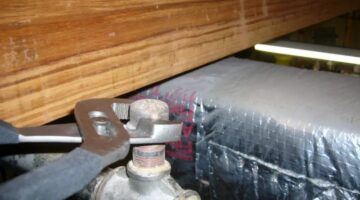
Be sure to open some windows to let the residual gas escape.
It will smell for a little while, but the gas fumes soon dissipate. Feel free to take a short break here.
- Joint compound
is probably the single most important purchase. It acts as THE bonding agent between connections and prevents gas leaks from occurring.
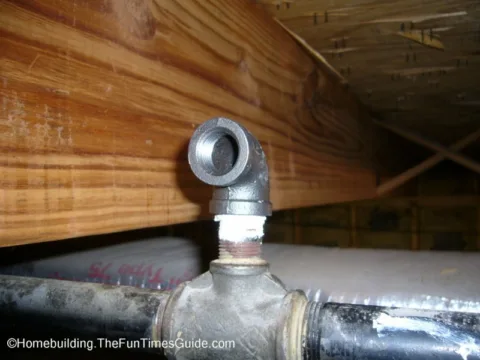
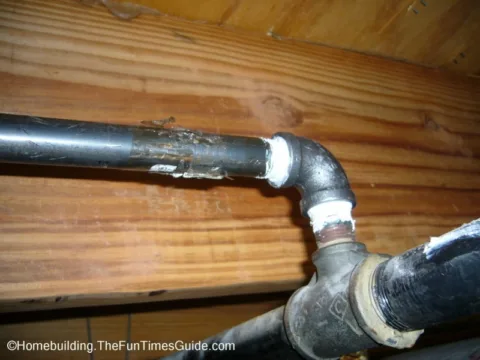
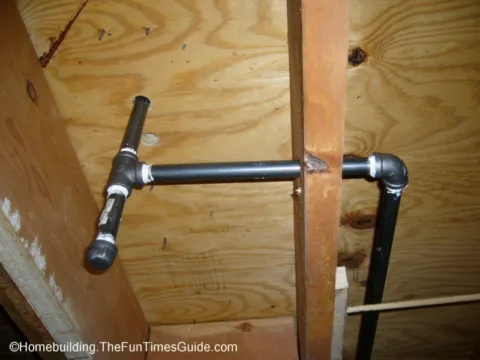
I basically just “painted it” onto the male threads — thick enough to not be able to see the threads, and that’s it. No gooping and layering. It’s not a cake!
I went from connection to connection, putting the “pipe dope” ONLY on the male threads.
I tightened each connection firmly but didn’t over do it so I wouldn’t split or crack a pipe. Hercules need not apply!
- The final piece in the gas pipe installation puzzle was the gas valve.
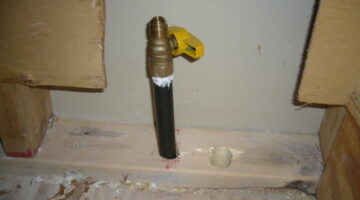
Simply follow the installation directions on the package.
That’s the last step with my DIY installation of the supply line for our new natural gas range.
But this next part is super important!…
Part 2 – The Gas Leak Test
This part of the job is EXTREMELY IMPORTANT. No shortcuts allowed here.
When everything was completely connected:
- I turned the gas back on at the meter.
- I mixed a concoction of half dishwashing liquid and half water in a small glass per the Home Depot guy’s advice (and what I had read on do-it-yourself websites).
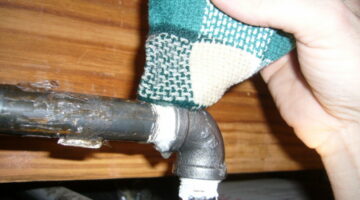
- After stirring it around and grabbing a rag, I then proceeded to dab the rag in the glass and then dab it onto each and every connection.
- You’re looking for bubbles! You MUST give a 360-degree look on each connection. Otherwise, you’re rolling the dice with your life and your loved ones.
- If you don’t see ANY bubbles forming, you’re golden. GIVE THE BUBBLES TIME TO FORM. The bubbles may not form right away — so take your time with this step…please!!!
- Wait a day, or two for the joint compound to cure.
- Finally, go back and cleanse each joint with clear water. This will prevent the compound from corroding over time.
TIP: We received a rebate from our local gas company for doing this ourselves. Check to see if there are any rebates available where you live!
Part 3 – Avoid Problems With Combustion Equipment
If you use a gas range, then you should use a properly sized range hood fan!
As a general rule, calculate 100 cfm for every linear foot of cooking surface. For pro-style ranges, the formula is 100 cfm for every 10,000 BTUs your appliance puts out. Other factors come into play as well. For every 3 inches a hood exceeds the suggested height above the cooktop, add 100 cfm. Island hoods require extra cfm to compensate for cross drafts, so calculate 150 cfm per linear foot for conventional cooktops; add an additional 100 cfm to the pro-range estimate. And consider how you cook. If you rarely grill or stir-fry at high heat, you may be able to go with a lower cfm than recommended.
~This Old House
Just know that the numbers are a little different when you install a natural gas range.
How to calculate the proper hood fan size for a gas range:
Gas stove burners produce more heat than electric burners do, so gas stoves require a larger fan. To determine the needs for your gas stove, you need to first begin with your stove’s BTU ratings. Combine the ratings for each burner and then divide by 100 to determine the minimum CFM. Typically, gas stove burners range from 5,000 to 18,000 per burner. On average, older 4-burner stoves have a total BTU of 40,000, but more modern stoves with professional settings or more than four burners may have higher BTU ratings. For a kitchen with a 40,000 BTU stove, the calculation would be as follows: 40,000 BTU stove ÷ 100 = 400 CFM
~Today’s Homeowner
Here’s a helpful word of advice from the EPA on Indoor Air Quality in Homes/Residences:
All kitchens should have exhaust ventilation to remove odors and excess moisture associated with cooking. While there are various ventilation strategies for kitchens, a range hood is the most common. When using a gas range, a range hood directly vented to the outside should be used to capture the combustion products. These range hoods should be sized correctly. For a typical kitchen range the American Society of Heating, Refrigerating and Air-Conditioning Engineers (ASHRAE) and the Home Ventilation Institute (HVI) recommend 100 cfm. Larger fans may need to have makeup air provided to avoid excessively depressurizing the house, causing backdrafting or other problems.
After installation of combustion and/or ventilation equipment, combustion equipment should be tested to be sure that it functions properly.
It is important that your installer conducts a worst-case depressurization test. This combustion safety test determines if any non-sealed combustion appliances will backdraft or spill combustion products into the living space. Tell your installer this test should use an established procedure such as Appendix D of the International Fuel and Gas Code or ASTM E1998 “Guide for Assessing Backdrafting and Spillage from Vented Combustion Appliances”.
And finally, there are some interesting things I learned about range vent hoods and downdraft ventilation in my conversation with kitchen expert Paul Ryan on the subject.